Practical ASCE/SEI 7-22 seismic design: structural systems, R, Cd, and Ω₀ coefficients, irregularities, seismic forces, analysis methods, drift, stability, diaphragm design, and detailing.
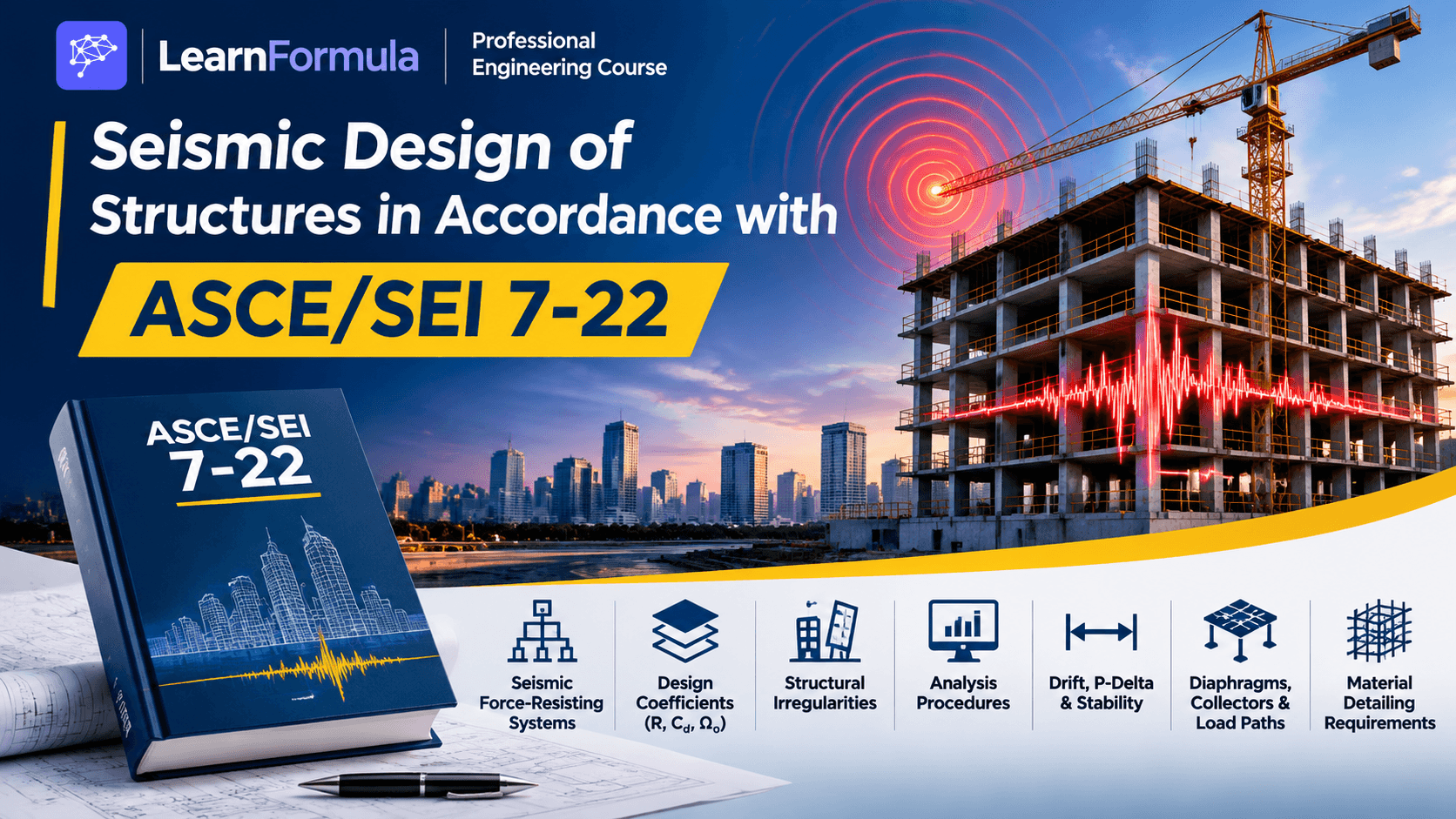
This practical 3-PDH course provides engineers with a structured, step-by-step understanding of the seismic design process for buildings and other structures in accordance with ASCE/SEI 7-22.
Seismic design requires more than calculating a base shear. Engineers must select an appropriate seismic force-resisting system, understand the design coefficients assigned to that system, recognize structural irregularities, choose a suitable analysis procedure, control drift and instability, design diaphragms and collectors, and coordinate the detailing requirements needed to achieve the intended ductile performance.
The course begins with the selection and classification of seismic force-resisting systems, including wall systems, steel braced frames, moment-resisting frames, dual systems, and cantilever-column systems. It explains how structural material, ductility, detailing quality, Seismic Design Category, and building-height limitations influence system selection.
Participants will examine the ASCE/SEI 7-22 seismic design coefficients, including the response modification coefficient, R; deflection amplification coefficient, Cd; and overstrength factor, Ω₀. The course explains how these coefficients relate to required strength, anticipated inelastic displacement, structural ductility, energy dissipation, and the design of critical elements and connections.
Horizontal and vertical structural irregularities are reviewed using practical building configurations. Topics include torsional irregularity, reentrant corners, diaphragm discontinuities, out-of-plane offsets, nonparallel systems, soft and weak stories, vertical geometric irregularities, and discontinuities in the seismic force-resisting system.
The course then addresses the calculation and application of seismic forces, including base shear, vertical force distribution, orthogonal effects, accidental torsion, redundancy, vertical seismic effects, and overstrength requirements.
Participants will compare the principal analysis procedures permitted by ASCE/SEI 7-22: Equivalent Lateral Force, Simplified Equivalent Lateral Force, Modal Response Spectrum Analysis, Linear Response History Analysis, and Nonlinear Response History Analysis. The course explains when each procedure may be appropriate and highlights its principal assumptions, advantages, and limitations.
The final sections cover story drift, building separation, P-delta stability, diaphragm classification and design, chords, collectors, transfer forces, deformation compatibility, continuous load paths, and material-specific detailing for wall systems, braced frames, moment frames, gravity systems, and light-frame construction.
By completing this course, participants will be better prepared to organize and review a code-compliant seismic design, select an appropriate structural system and analysis method, recognize conditions requiring special consideration, and coordinate strength, stiffness, stability, diaphragm, and detailing requirements using sound engineering judgment.
2 activities • 1 chapters • duration: 3 hours

Professor of Reinforced Concrete Structures | Structural & Forensic Engineering Consultant | Wyoming-Licensed P.E. | CPD Course Author
Dr. Ibrahim M. Metwally, Ph.D., P.E., is a Wyoming-licensed Professional Engineer specializing in civil and structural engineering, structural and forensic engineering consultancy, and continuing professional education. He serves as Professor of Reinforced Concrete Structures at the Housing and Building National Research Center (HBRC) in Cairo, Egypt. He is the Founder and Principal Consultant of ENGISTRUCTA™ | Structural Excellence, a structural and forensic engineering consulting practice registered in Wyoming. He is also registered as an independent structural engineering consultant with the Wyoming Department of Transportation (WYDOT) and as a structural consulting engineer with Egypt’s Ministry of Housing, Utilities and Urban Communities. With more than 30 years of academic, research, and professional experience, Dr. Metwally specializes in structural analysis and design, forensic investigation, structural assessment, rehabilitation and strengthening, seismic and wind engineering, performance-based evaluation, and advanced nonlinear finite element analysis. His technical expertise encompasses reinforced concrete, structural steel, prestressed and post-tensioned concrete, deep foundations, structural masonry, bridges, buildings, and infrastructure systems. His professional experience includes the design, review, evaluation, rehabilitation, and failure investigation of major structures across Egypt and the Arabian Gulf region, including projects involving deterioration, structural distress, complex loading conditions, and extreme environmental effects. His academic and research interests include ultra-high-performance concrete (UHPC), fiber-reinforced polymer (FRP) structural systems, large-scale experimental testing, seismic performance, and the behavior of concrete structures under extreme loading. As an author and technical reviewer of continuing professional development (CPD) courses for professional engineers, Dr. Metwally integrates current codes and standards, advanced technical knowledge, worked examples, and practical engineering judgment. His educational materials help practicing engineers strengthen their capabilities in structural design, assessment, rehabilitation, forensic engineering, and code compliance.
